
Comtech Research
Your Source for
Indoor Air Quality
In business since 1989
About our IG-133- model series High-Output Ionizers
|
|
Phone orders: 866-466-4937 | NEWS |

 Ionizer
Products
Ionizer
Products
Negative
Ions info
Ozone
info
Ordering
info
Secure
purchase
Contact
Us
Site
Map
Search
Home
Back
What
can I expect from your negative ionizers?What
are your guarantee and warranty policies?Do
your ionizers cause "black wall?How
do your ionizers compare to other brands?How
do your ionizers generate negative ions?What
can negative ions do?What
about the Air Probe Sanitizer UV system?
(See also
our FAQ on our original web site.)
Q:
How Do You Measure the Amount
of Negative Ions that your negative ionizers produce?
A:
We test the total negative ion output out of the ion
emitter per second (approximately 90 to 100 trillion) using more than one
method.
- We do different tests of the ion output using several
proprietary methods that we have developed in our labs.
-
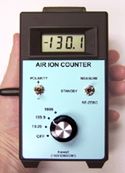 We
use Alpha Labs digital air ion counters. The ion concentration at one meter (39")
away from the emitter is 1,000,000 negative ions per cubic centimeter. These
measurements are done in rooms with no fans and roughly 45% humidity.
Multiple readings were done at each location and for every model to
ensure accuracy.
We
use Alpha Labs digital air ion counters. The ion concentration at one meter (39")
away from the emitter is 1,000,000 negative ions per cubic centimeter. These
measurements are done in rooms with no fans and roughly 45% humidity.
Multiple readings were done at each location and for every model to
ensure accuracy.
These tests ensure accuracy beyond what is actually necessary.
We used to not publish these ions per cubic centimeter figures, because they vary greatly with the distance from the emitter, humidity, and air movement within the room.
The bottom line is that our ionizers do indeed emit a
high and optimum level of negative ions into a room. The coverage is approximately
400 square feet (e.g. a 20' by 20' room). That's 4000 cubic feet, if you
have 10' high ceilings.
Q:
What can I expect from your
negative ionizers if I buy one?
A:
- You can expect to breathe freshened, purified air,
with much of the pollen, dust, pet dander, and other allergy causing
particles removed from the air in your room. And it's not called the
Happy Machine™ for no reason! Many of our customers also report
these results.
- You can also expect a large number of negative ions
to be produced externally, that is, out into the room away from
the ionizer (and we include a simple ion detector with each unit to prove
it).
What's so special about that? Some other products with the word "Ion" in their brand name (or product description) produce only negative ions internally, and few, if any, negative ions actually leave the "negative ion generator" and go out into the room. Some actually generate positive ions.
- You can expect the negative ions to neutralize positive
ions that emanate from your TV or computer monitor.
Q:
What are your Guarantee,
Returns, and
Warranty policies?
Q:
"I would like to know if
your ionizers make a dark spot on my wall.
Mine [another brand] was sitting on the mantel."
A:
We can count the number of 'black wall' (gray
wall) complaints on one
hand, and have fingers left over, for all the thousands of negative ionizers we've ever
sold. You were probably burning dirty-burning candles, possibly with a lead
wick (which would have sooted up the walls anyway, even with no ionizer
present).
It is possible, though, for any high-output negative ion generator
to do this, especially if you place the unit too close to the wall
and have high levels of pollutants in the air in your room. Burning some
kinds of candles can do this, whether or not you have an ionizer.
It sounds as if you live in an environment (or did live in one) that
is either very polluted, if you have experienced a dark spot on the wall.
We suggest that whatever ionizer you purchase, that you place it as far
away from walls and other objects as possible. The mantel, close to the
wall, is the wrong place to put any ionizer, ours or anyone else's. (See
"What is the best place to put an ionizer" on this
page). The ion emitter design, contrary to some claims you may have seen,
has nothing to do with how much dust, etc. accumulates on the wall.
Having said that, our IG-133DG
ionizer with built-in DustGrabber™ minimizes or eliminates dust and dirt on nearby objects when the ionizer
is too close, and in highly polluted areas such as where someone smokes. The IG-133DG
ionizer can also be ordered with mounting brackets for mounting to the wall or ceiling.
Q:
How do your ionizers
compare to "Brand X" ionizers?
A:
Please click here to see this information.
Q:
How do your
ionizers generate negative ions?
A:
By applying a safe, extremely low-current, negative high
voltage to tiny points on the ends of the ion emitter. Electrons then build up on
these points, form a corona discharge, and are ejected into the air
where they attach themselves to oxygen atoms. Since the electrons have a
"negative" charge, the atoms of oxygen with those new extra
electrons then become negative ions.
This is the only method possible to generate high-density negative air
ions, that is, the high levels necessary to affect most people's moods.
The voltage level and negative ion emitter design in our ionizers is
chosen to optimize the level of negative ions in the room, all without
producing unwanted ozone.
Q:
What do negative ions do?
A:
Please click here to see information on negative
ions.
Q:
What are the specifications
of the ionizers?
A:
We have actually measured over 93 trillion negative ions
per second output. And this goes up when something or someone gets close
to the ion emitters.
The continuous output measured at a standard distance of one meter (39 inches) from the emitter is 1,000,000 ions per cubic centimeter. This is truly a high-density negative ion concentration.
The actual ion output depends on the air movement, humidity* in the room, and the condition** of the ion emitters, but the average output does not vary a great deal from this. These ionizers do indeed emit a high and optimum level of negative ions into the room.
The coverage is approximately 400 ft2 (400 square feet, a 20' by 20' area). That's 4000 cubic feet, if you have 10' high ceilings.
These compact units plug into any standard 120 volt AC outlet (other voltages available). Draws very little power (less than 1 watt!), so is exceptionally economical to operate.
The IG-133, IG-133A, and IG-133DG negative ionizers measure only 5 by 5.25 inches by 1.5 inches tall (up to 7 inches tall, including the ion emitter).
* The ion output and coverage of ionizers decrease somewhat at
very low humidity. This effect is minimized in the IG-133A and IG-133DG
models.
** All ion emitters on negative ion generators deteriorate. However, Comtech Research has developed ion emitters on their negative ion generators which are both long-life, user- renewable, and replaceable! Simply trim the ends of the fine wires on the SSE ion emitter (on top of the unit) occasionally with a pair of wire cutters, according to the instructions, to keep the ion output at its peak.
And our long-life CFE ion emitters are made from a high-tech, space-age material that is virtually maintenance-free. The CFE ion emitter requires no trimming, since the diameter of the fibers is almost microscopically small (only 0.8 microns). And dusting off the emitter is only needed 2 or 3 times a year.
What
is the difference between the ionizers?What is
the best way to place an order?How long
will it take to receive my order?How
are negative ions different from ozone?Do
your products generate ozone or oxides of nitrogen?Will
negative ions hurt my plants or my pets?Are
there any disadvantages to buying the two units combined into one (IG-133DG)
versus the two separately (IG-133A and DC-2 DustGrabber)?
Q:
What is the Best Place to
Put an Ionizer?
A:
We suggest placing the ionizers on the front edge of a table,
dresser, or nightstand. It should be
a couple of feet or more from nearby objects, so that most of the
negative ions will go out into the air in the room where you want them rather than being attracted to nearby
surfaces.
You should not place your
ionizer in places like these: inside a bookshelf, on a mantel directly
against a wall, or right next to another object. Why not? Because in those
situations, some negative ions will be drawn to the nearby object or surface
instead of dispersing throughout the room as they should be.
Many of our customers put one ionizer in their bedroom
and another one in their living area. You can place them about anywhere
that you would like, with the guideline here in mind. You might experiment,
that is, move them around and see which room is best for you. We suggest
against putting any electrical appliance in a bathroom.
If you're only buying one ionizing air purifier, then
experts suggest placing it in the bedroom (and we concur). Even though the
negative ionizers are rated to cover 400 square feet with high density negative
ions, it is really not necessary to get one for each room. However, it would
be a good idea to place them where the air naturally is flowing from one
room to another (the airflow will help carry the negative ions into the
next room). Keep in mind that negative ions cannot travel from one floor
to another (nor through walls).
If you have computers, placing an ionizer two or three
feet from a computer monitor (to your right or left) will help neutralize
the positive ions that emanate from the monitor. NOTE:
an LCD monitor, such as used on a laptop/notebook portable computer does
not normally produce positive ions.
Q:
What is the difference between
the IG-133 and the IG-133A ionizers?
A:
The model IG-133A and IG-133DG have metallic surface(s) on top that improves
the performance and ion output of the unit slightly. It is less susceptible
to decreases in negative ion output when the room humidity is low, such
as indoors in the wintertime (with no humidifier), in an air-conditioned
room, or in a desert environment.
If you live in a dry environment (dry in any part of the year), we suggest that you NOT order the IG-133 negative ionizer. However, if you live in a humid environment year-round, you can order the original IG-133 negative ion generator and save a few dollars.
The IG-133DG has the same ionizer circuit that the other two models do, plus an extra circuit inside connected to the two metallic surfaces on top (DustGrabber™). It is recommended for highly polluted environments, and was initially developed because some people didn't like the dust that settled on the table right next the ionizer. Instead, most of the dust is attracted to those two metallic surfaces.
Q:
What is the best way to place
an order?
A:
You may place a secure order online 24 hours a day
here on our order page. You may also
call us toll-free during normal office hours and place your order.
Q:
How long will it take to
receive my order?
A:
Items offered on our web site are stocked and usually ship
the same day or the next business day.
Shipping times
Q:
How are negative ions different
from ozone?
A:
Click here to view the ozone FAQ
page.
Q:
Do your products generate
ozone or oxides of nitrogen?
A:
All our IG-133 series ionizers and the IG-1215 are
genuine negative ion generators, and not ozone generators.
Some "negative ion generators" being sold
are really ozone generators, and deliberately generate large quantities
of ozone and positive ions (yes, that is true). Ours do not. Neither do
our ionizers produce any nitrogen oxides.
Ozone FAQ
We do sell some products such as the XJ-3000C, if you need a little ozone in a room ionizer to rid your home of odors.
Q:
Will negative ions hurt my
plants or my pets?
A:
No. Negative ions are not toxic or harmful
to either people or pets. We once even had a report that a particularly
playful kitten chewed on an ion emitter while the ionizer was running, with
no harm to the cat.
As for plants, they will likely help the growth of any plants you have nearby.
Q:
Are there any disadvantages
to buying the two units combined into one (IG-133DG)
versus the two units separately (IG-133A and
DC-2 DustGrabber)?
A:
Not really. Operating the IG-133A and the DC-2 DustGrabber™separately
emits the same amount of negative ions as the combined IG-133DG unit. If
you purchase the IG-133A and DC-2 and operate them side by side, you will
notice that the DC-2 DustGrabber collects a little more dust than the IG-133DG
combo unit.
The DC-2 is mostly for people who already have a negative ion generator.
For more information, please visit our FAQ on our original web site (opens in new browser window).
FAQ about the
Air Probe Sanitizer™
Negative ions information | Ions vs. ozone | Scientific research | Proof Positive
