Ultraviolet-C Light: Lamp Comparison Charts
UV-C Lamps for Air Purification
All "UV-C Light" is NOT the same.
|
|
Phone orders: 866-466-4937 | NEWS |

Inferior
"UV-C" Ultraviolet Lamps
used in cheap copies
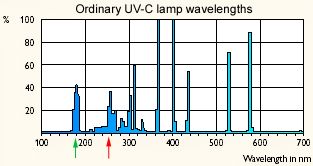
This chart shows
the weak, impure
ultraviolet spectrum of inferior "UV-C" lamps.
Wasted energy,
Unwanted Ozone,
Dangerous UV-B radiation.
SHORT LAMP LIFE
Genuine UV-C Ultraviolet Lamps
used in the Original
Air Probe Sanitizer™
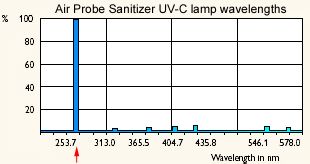
This chart shows
the
Powerful,
Pure UV-C spectrum of the Optimal
Original Air Probe
Sanitizer lamps.
Nearly pure UV-C
Produces optimal results
and absolutely NO ozone.
LAMPS LAST YEARS
-
Note the low power output of this inferior lamp at
the 254 nm* germicidal wavelength.
These lamps are inferior at zapping odors, dust, mold, etc.
Only the 254 nm germicidal** wavelength above the red arrow is actually effective and produces purifying hydroxyl.
- And note the unwanted ozone-producing energy above the green arrow.
Ozone
can damage air conditioner coils.
Ozone can cause the aluminum fins in your air conditioner's cooling coil to corrode and separate from the copper
refrigerant lines.
- This impure UV light also generates dangerous (not to mention useless) UV-B radiation,
which can blind if accidentally viewed even for a short time.
Unlike UV-C, it can penetrate the lens of the eye and destroy the retina.
- And there are many wasted energy 'spikes' (the vertical blue lines). That means less energy is available at the critical 254 nm germicidal wavelength.
** Does much more than kill germs.
-
Note that almost all the UV-C energy emitted
by the Air Probe Sanitizer™ lamps is concentrated at the all-important 254 nm germicidal
and hydroxyl-producing wavelength (above the red arrow).
-
The Air Probe Sanitizer™
produces
ZERO ozone.
- And there is almost no wasted energy
in visible light, UV-A or UV-B emission, due to the superior lamp design.
It is important to see this sharp vertical energy spike at this
critical 253.7 wavelength (red arrow in above chart).
- That means maximum UV energy is available purify the air and kill germs. This means that fewer UV lamps are needed. These lamps generate intense UV-C rays, 2500 times the amount of UVC that reaches the earth's surface on a sunny day.